

Choosing between mainland vs free zone vs offshore is the first real decision in a UAE company setup. Ownership is no longer the dividing line for most founders. Customers, visas, banking, and tax are.
If you are still mapping the route, start with our guide to business formation in the UAE. The licence you pick decides where you can sell, who you can hire, and how a bank will read the file.
Exactitude Business Services advises founders, family groups and overseas companies on this choice every week from our Dubai office. The notes below follow the questions clients actually bring to the first meeting.
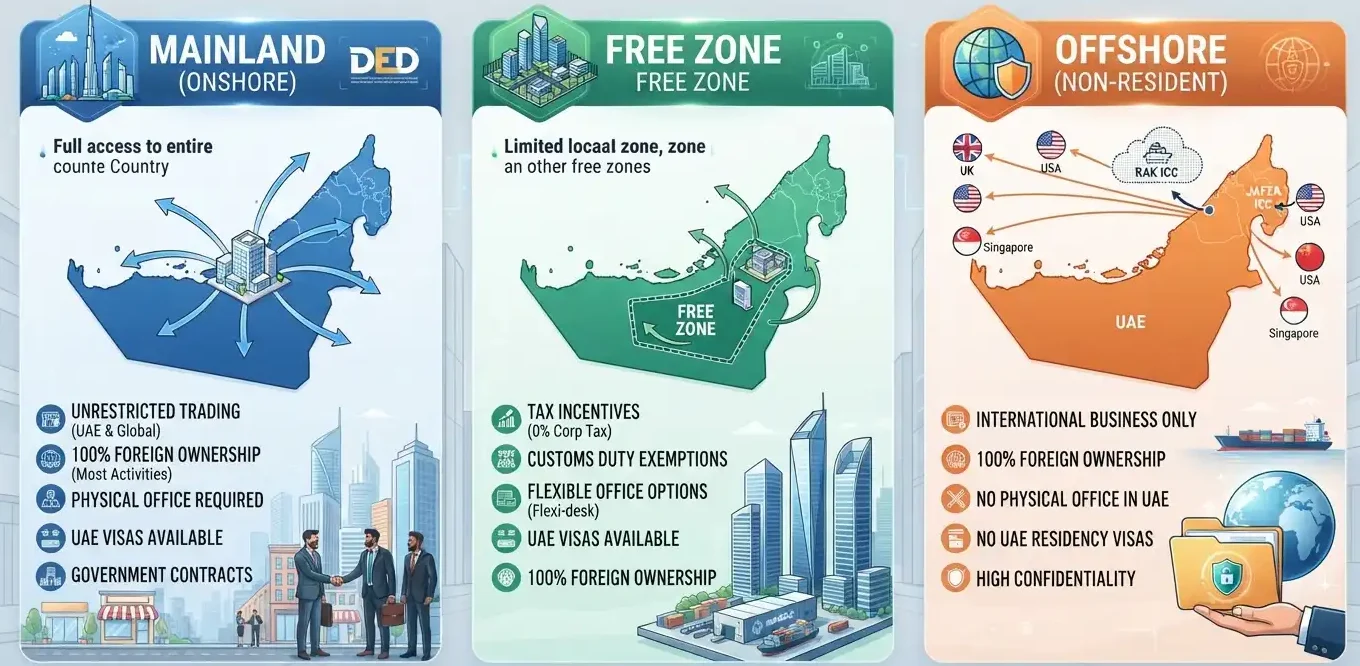
What is the difference between Mainland vs Free Zone vs Offshore
Mainland vs free zone vs offshore is a difference of jurisdiction, not of quality. Each vehicle is a real UAE company. Each has a registrar, a licence or registration, and a set of rules about what it may do.
A useful way to hold the three apart is this. A mainland company is licensed to trade in the UAE market. A free zone company is licensed to operate from a zone, usually with international reach and limited direct access to the local market. An offshore company is a holding or international vehicle. It is not a trading licence for business inside the UAE.
What is a mainland company?
A mainland company is licensed by an emirate authority. In Dubai, that authority is the Department of Economy and Tourism. The company can sell to customers anywhere in the UAE, open a branch in another emirate, and, where the activity allows, bid for government and semi-government work.
For most commercial, professional, and industrial activities, a foreign founder can hold 100 percent of the shares. That position follows the UAE Commercial Companies Law, Federal Decree-Law of 2021. It is not universal. Cabinet rules still list activities of strategic impact, including certain banking, insurance, defence and security work, where local participation can still be required. Some professional licences also use a local service agent. That agent is not a shareholder.
A mainland file almost always needs a physical office and an Ejari tenancy contract. Visa quota is tied to that space. Setup is rarely the cheapest path, and it is often the right one when the customer sits in Dubai, Abu Dhabi or another emirate.
Our page on mainland company formation in Dubai sets out the licence path in more detail.
What a free zone company is
A free zone company is licensed by a free zone authority, not by the mainland Department of Economy and Tourism. Well-known options include IFZA, Meydan, DMCC, Dubai South, RAKEZ, SHAMS. Each zone publishes its own activities, facility rules, and visa packages.
Foreign ownership is 100 percent as standard. Profit can be repatriated. Many zones accept a flexi-desk for a service or trading licence, which keeps the first-year cost down. A warehouse, light industrial unit or fitted office is required when the activity needs it.
The limit is market access. A free zone company can trade inside its zone and with customers outside the UAE. Selling directly to a mainland customer is not automatic. The usual routes are a mainland distributor, a commercial agent, a dual licence, or a mainland branch where the emirate allows it. Dubai has widened some of those routes since 2025. They still need an extra approval, and they can change the tax and VAT picture.
Free zone corporate tax is the point most often misunderstood. A qualifying free zone person can pay 0 percent on qualifying income. The status is not granted by the licence alone. Substance, qualifying income, audited accounts, and the de minimis rules all have to be met. Income that fails those tests is taxed at 9 percent.
What an offshore company is
An offshore company in the UAE is usually a RAK ICC company or a JAFZA offshore company. It is formed for holding, asset ownership, international contracting, or group structuring. It receives a registration, not a licence to trade in the UAE.
It cannot invoice UAE customers for local goods or services. It does not receive a residence visa quota. It does not need an Ejari office. A registered agent provides the address. Annual cost is often the lowest of the three, because there is no facility and no immigration file.
Banks treat offshore files more strictly. Some onshore banks will not open an account for a pure holding company. Where an account is possible, the bank will ask for a clear purpose, attested parent papers and a full source-of-wealth story. Property use is also narrower than many buyers expect. A Dubai freehold title is a Land Department decision, not a feature of the offshore certificate. We cover that separately in our note on whether a Dubai offshore company can own freehold property.
The difference in one view
| Point | Mainland | Free zone | Offshore |
| Registrar | Emirate authority, such as Dubai DET | Free zone authority | RAK ICC or JAFZA Offshore |
| Foreign ownership | 100% for most activities | 100% as standard | 100% as standard |
| UAE market | Direct, across the UAE | In-zone and international; mainland needs an extra route | Not for UAE trading |
| Government work | Often eligible | Usually limited | Not designed for this |
| Office | Physical office and Ejari | Flexi-desk often accepted | Registered address only |
| Residence visas | Yes, tied to space | Yes, tied to the package | Typically none |
| Corporate tax shape | 9% above AED 375,000 taxable income | 0% on qualifying income if QFZP tests are met | Usually outside scope if there is no UAE business |
| Banking file | Familiar to local banks | Accepted when activity and substance are clear | Harder; purpose must be explained |
| Best fit | Local clients, retail, contracting | Export, regional HQ, digital, specialist clusters | Holding shares, IP or assets |
Figures and rules move. Treat the table as a planning frame, then confirm the activity on the current authority list before you pay a licence fee.

How to compare them and what we recommend for different businesses according to their activity
A clean comparison of mainland vs free zone vs offshore starts with the customer, not with the fee. We ask five questions before we name a jurisdiction.
- Who pays the invoice, and in which country do they sit?
- Do the founders need a UAE residence visa this year?
- Will the company hire staff, and how many?
- Does the activity need a shop, a clinic, a yard, a warehouse or only a desk?
- Will a UAE bank account be required in the first 90 days?
If the answers point in different directions, the structure should follow the answer that is hardest to change later. A visa can be added. A wrong market right is expensive to unwind.
Local trading, retail and on-site services
A shop, a restaurant, a salon, a clinic, a fit-out contractor or a facilities company that visits client sites should be mainland. The customer is in the UAE. The work happens outside a free zone fence. A free zone licence will not cover that activity just because the fee is lower.
Mainland also fits a business that wants to bid for government or semi-government contracts. Free zone companies are generally outside that tender pool.
Import, distribution and warehousing
Import for re-export, or trading from a bonded facility, often sits well in a free zone with logistics depth, such as JAFZA or Dubai South. The zone facility, customs handling, and visa package can be shaped around the warehouse.
Import for sale to UAE retailers and projects is a mainland question. Some groups use both: a free zone trading company for international purchase, and a mainland company for local sale. That only pays off when the volume justifies two licences, two banks and two sets of books. For a first container, one mainland trading licence is usually cleaner.
Consulting, software and online services
A consultancy, software firm or digital agency that invoices clients outside the UAE can use a free zone. Setup is faster, a flexi-desk is often enough, and a qualifying free zone position may keep qualifying income at 0 percent if the substance tests are met.
The same firm should move to mainland if most clients are UAE companies and the work is delivered on their premises. A dual path exists, but it is an extra licence, not a shortcut.
E-commerce
Selling to customers outside the UAE can sit in a free zone. Selling to customers inside the UAE, storing stock in a Dubai warehouse and delivering locally, points to mainland, or to a free zone plus a mainland sales route. Marketplace rules and payment providers also ask for a licence that matches the place of supply. Do not assume a free zone certificate will satisfy a local payment partner.
Holding shares, intellectual property and family assets
An offshore company is built for this. It can hold shares in operating companies, hold intellectual property, or sit in a family chart. It should not employ staff in Dubai or invoice a UAE client.
If the holding company also needs a UAE bank account and a residence visa for the principal, a mainland or free zone holding activity is often the more practical vehicle. Offshore remains useful beside it, not instead of it. Foundations in DIFC or RAK ICC are a separate conversation when succession, not trading, is the aim.
Regulated and specialist activities
Banking, insurance, exchange, some investment services and certain professional licences do not follow the general 100 percent rule. Financial free zones such as DIFC and ADGM use their own common-law frameworks and their own regulators. Those are not interchangeable with a standard free zone trading licence. If the activity is regulated, the regulator is chosen before the free zone brochure is opened.
A short recommendation by activity
- UAE consumers, shops, clinics, restaurants, site work: mainland.
- Government or semi-government supply: mainland.
- International services with a founder visa: free zone.
- Export trading from a zone warehouse: free zone with the right facility.
- Local distribution of imported goods: mainland, or mainland plus free zone only if volume supports both.
- Shareholding, IP holding, asset holding, no UAE staff: offshore.
- Property holding: confirm Land Department acceptance before you incorporate. Do not assume offshore title.
- Regulated finance: DIFC, ADGM or the relevant mainland regulator, not a general trading zone.
Cost still matters. It should be read after the activity fit. Our UAE business setup cost breakdown sets out first-year bands so the fee is not a surprise after the jurisdiction is chosen.
Banking, visas, tax and office: where the three paths separate
Banking
A licence does not open a bank account. The bank onboards the people, the activity and the expected flows.
Mainland companies usually present the most familiar file: a DET licence, an Ejari office and a local operating story. Free zone companies are accepted across the market. Files move faster when the zone is known and the workspace is more than a name on a flexi-desk. Offshore companies face the highest bar. A holding purpose must be explained in plain language, with source-of-wealth evidence that matches the shares.
We prepare the bank file with the formation, not after a rejection. The practical issues are set out in our notes on corporate bank account opening and on why businesses struggle to open UAE bank accounts.
Visas
Mainland visa quota follows office size. A larger Ejari supports more residence visas, subject to immigration rules. Free zone visas follow the package you buy. A one-visa flexi-desk will not later sponsor a team of twenty without a facility upgrade. Offshore registration does not sponsor residence visas.
Investor and partner visas still require the applicant to hold the stake the authority asks for, and to pass the medical and Emirates ID steps. A Golden Visa is a separate eligibility test. It is not included in a standard licence.
Tax and books
Corporate tax applies under Federal Decree-Law of 2022. The headline rate is 9 percent on taxable income above AED 375,000. There is no personal income tax.
A mainland company sits in that standard regime. A free zone company sits in it too, unless it qualifies as a qualifying free zone person and keeps qualifying income inside the 0 percent gate. Elections, related-party rules and audited accounts are part of that gate. Small business relief has been available, on election, for eligible businesses under a revenue cap for tax periods ending on or before 31 December 2026. It is time-limited and conditional. It should not be built into a five-year model without checking the current Cabinet decision.
VAT registration is mandatory once taxable supplies exceed AED 375,000. Free zone to free zone supplies are not automatically outside VAT. Offshore companies with no UAE establishment are often outside VAT, until a UAE permanent establishment appears.
Books, a tax registration where required, and an e-invoicing plan now sit beside the licence. Our pages on accounting and bookkeeping and corporate tax and VAT compliance in the UAE cover the ongoing file.
Office and substance
Mainland needs a real tenancy. Free zone substance can be a flexi-desk, a fitted office or a warehouse, depending on activity and on whether you want qualifying free zone treatment. Offshore needs a registered agent, not a desk. If you later claim that an offshore company has no UAE business, do not build a Dubai operating team under that name.
What the choice feels like from the client side
Founders rarely arrive with a neat chart. They arrive with a broker screenshot, a visa deadline, and two different quotes.
A typical first conversation sounds like this. The client has been told a free zone is always cheaper and always enough. The client’s own pipeline is three Dubai contractors and a facilities contract that has to be delivered on sites in Jebel Ali and Al Quoz. On paper, the free zone fee is lower. In practice, the licence would not cover the sites, the bank would ask why a zone company is invoicing mainland projects, and the visa count on a flexi-desk would not cover the supervisors. We reframe the quote around a mainland trading and services licence, an Ejari that matches the headcount, and a bank file built on the contracts already in hand.
Another client is the reverse. The work is software, the clients are in Europe and the Gulf outside the UAE, and the founder needs one residence visa. A mainland office would add rent without adding a customer. A free zone package with a flexi-desk, a clear activity and a simple invoice story fits. We still write down the qualifying free zone tests, so the 0 percent rate is a target, not a promise printed on the licence.
A third file is a family that wants to hold shares and a Dubai apartment. They have been offered an offshore company as if it were a trading licence and a title deed in one. It is neither. We separate the holding question from the property question, confirm what the Land Department will register, and only then incorporate. The relief clients describe afterwards is not about the lowest fee. It is about signing a structure they can explain to a bank, an auditor, and a customer without rewriting it in year two.
How Exactitude Business Services expert consultants help you in it
Exactitude Business Services is a Dubai business advisory firm. We handle formation, banking preparation, PRO work, accounting, and tax compliance for mainland, free zone, and offshore files. Consultants work from the activity list, shareholder papers, and bank questions, not a licence menu.
This is how we help a founder compare mainland vs free zone vs offshore and then complete the file.
- We start with the activity. The wording on the licence has to match the invoice you will raise. A mismatch is the most common reason a bank pauses a file.
- We test market access. If you need to sell in the UAE, we do not place you in a zone that cannot support that sale.
- We price the full first year. Licence, facility, visa, establishment card, immigration, and the likely bank deposit are listed before you pay.
- We prepare corporate documents, ultimate beneficial owner forms and the legalised papers a foreign shareholder usually needs.
- We align the bank narrative with the licence. Expected counterparties, currencies and monthly turnover are written in the same language as the business plan.
- We coordinate PRO steps, medicals, Emirates ID and establishment cards where a visa is part of the plan. Our PRO services in Dubai cover that track.
- We set the accounting and tax calendar at incorporation, including VAT and corporate tax registrations when the thresholds or the activity require them.
- We stay after the licence. Activity changes, extra visas, a mainland branch, and a later liquidation are easier when the same consultant holds the history.
You can review the wider scope on our services page and the firm background on our about page. A first consultation is free. Bring the activity, the shareholder list, and the country of your customers. We will tell you if mainland, free zone or offshore is the wrong tool before any fee is paid.
A practical next step
If you are choosing between mainland vs free zone vs offshore, do it against your contracts, not against a package price. Exactitude Business Services can map the activity, the visa need, and the bank file in one sitting, then run the formation if the structure is right.
Write to sales@exactitudebusiness.com, call +971 52 177 1150, or use the contact page. The office is at Office 601, 6th Floor, Mai Tower, Dubai. Ask for a structure review. Mention the activity and where your customers sit. We will reply with the jurisdiction we would actually use, and the reason we would not use the other two.
Frequently asked questions
What is the difference between mainland vs free zone vs offshore?
A mainland company can trade across the UAE. A free zone company operates from its zone and internationally, and needs an extra route to sell on the mainland. An offshore company is for holding and international structuring. It cannot trade inside the UAE and does not issue residence visas.
Can a foreigner own 100 percent of all three?
Yes for a free zone company and an offshore company. Yes for most mainland activities under the Commercial Companies Law. Strategic activities and some professional licences still require local participation or a local service agent. Confirm the activity before you incorporate.
Which is better for a small consulting firm?
If clients are outside the UAE and you need a residence visa, a free zone is usually the better fit. If clients are UAE companies and the work is delivered on their sites, mainland is the safer licence.
Can a free zone company sell to mainland customers?
Not as a general right. Common routes are a distributor, an agent, a dual licence or a mainland branch where the authority allows it. Each route has a cost and can affect VAT and corporate tax. Get the route approved before you invoice.
Does an offshore company get a visa and a bank account?
It does not get a residence visa quota. A bank account is possible at some institutions, but approval is slower and often refused where the company has no clear international purpose. Do not plan a UAE life on an offshore registration alone.
Which structure pays the least tax?
There is no automatic winner. Mainland profit above AED 375,000 is taxed at 9 percent. A qualifying free zone person can pay 0 percent on qualifying income if substance and income tests are met. An offshore company with no UAE business is often outside UAE corporate tax. The label on the certificate does not decide the rate. The activity and the substance do.
How long does setup take?
A straightforward free zone or offshore file can be completed in a few working days once documents are legalised. A mainland file takes longer because of the office, external approvals, and activity wording. Banking sits on top of the licence and has its own timeline.
Can I change from one structure to another later?
You can add a branch, open a second company, or close and reincorporate. A simple “conversion” is not always available, and it is rarely cheaper than choosing correctly at the start. Activity changes inside the same jurisdiction are easier than moving customers from a zone licence to a mainland contract.
Do I need an office on day one?
Mainland, yes. An Ejari tenancy is part of the file. Free zone, often a flexi-desk is accepted for service and light trading activities. Offshore, no office, only a registered agent. If you want qualifying free zone tax treatment, budget for real substance, not only the cheapest desk.
How do I start with Exactitude Business Services?
Share your activity, shareholder nationalities, and customer countries through the contact page or sales@exactitudebusiness.com. We compare mainland vs free zone vs offshore against that brief, then handle formation, banking preparation, and PRO steps if you want to proceed.